
Clean energy advice for Ohio homes, where the solar rules were just tested and kept
Ohio’s largest utility asked regulators to cut what rooftop solar earns. The commission reviewed the request, heard from every side, and left the net metering rule exactly as written.
That outcome matters more than it sounds. Homeowners weighing solar anywhere usually ask the same question: will the terms I sign up under still be there in a few years? In Ohio the rule has just been through its scheduled five-year review, including a direct challenge, and came out unchanged.
What stays in place is a crediting method that rewards a well-matched system: power you use at home displaces electricity at its full delivered price, and any surplus becomes a bill credit that rolls forward. Our advice is independent, so the work is fitting those terms to your household, not to the largest array the roof will hold.
Ohio solar in four lines
A rule that held
Regulators finished the latest five-year review of net metering and kept the rule unchanged.
Home use saves the most
Solar consumed as it is made offsets the full delivered price of electricity.
Credits that roll forward
Monthly surplus becomes a bill credit at the supply portion of the default rate and carries on to later bills.
A simple path to connect
Typical home systems qualify for the shortest interconnection review under rules updated in 2026.
Where a battery fits in Ohio’s crediting
In states that credit exports at the full retail price, the grid behaves like free storage and a home battery is mostly about backup. Ohio splits the value instead. A midday surplus earns the supply-side credit, while the same energy used after sunset would have saved you the whole delivered price, wires and all.
A battery bridges those two. Charging from the afternoon surplus and discharging through the evening turns exports into self-use, and it keeps the furnace blower, the fridge and the sump pump running when a storm takes the lines down. For many Ohio households, solar and storage planned as one system is the strongest version of the project.
Two destinations for the power your roof makes
| Used in your home | Exported to the grid | |
|---|---|---|
| What it replaces | Power you would have bought | Nothing — it leaves the house |
| How it is valued | The full delivered price | The supply portion of the default rate |
| When you see it | Straight away, as a smaller bill | As a credit that rolls forward |
| How to get more of it | Daytime loads, smart scheduling, storage | Sensible sizing to your annual use |

What the review actually confirmed
The utility’s request would have reshaped how solar homes pay for the distribution system and narrowed which customers the utility credits. The Public Utilities Commission of Ohio heard from utilities, suppliers, consumer advocates and solar groups, along with a few hundred comments from the public, and concluded the proposal lacked the evidence for a change that large.
So the essentials carry on: one two-way meter, a monthly credit for surplus valued against your utility’s standard service offer, and credits that keep rolling onto future bills. Default supply prices in Ohio are set through wholesale auctions, and because the export credit is tied to that supply price, it moves with it.
Who owns your wires decides which rulebook applies
AEP Ohio, FirstEnergy’s three Ohio companies, Duke Energy Ohio and AES Ohio
Ohio’s investor-owned utilities must offer a net metering tariff under the state rule. AEP Ohio serves Columbus and large parts of the south and west; FirstEnergy operates as Ohio Edison, The Illuminating Company around Cleveland, and Toledo Edison; Duke Energy Ohio covers greater Cincinnati; AES Ohio serves the Dayton area. Your address settles which one you have, and the crediting method is the same across all of them.
Cooperative and municipal systems set their own terms
Rural electric cooperatives and city-owned utilities fall outside the commission’s jurisdiction, and the state rule does not require them to offer net metering. Some offer their own version, but the terms are local, so if a co-op or a city utility sends your bill, we start by reading its tariff rather than assuming the statewide rule.
Your supply contract can matter too
Ohio lets you buy electricity supply from a competitive supplier or through a community aggregation program, and the rule allows those arrangements to carry their own export terms. It is a quick thing to check, and worth doing before you switch supply deals once panels are on the roof.

How an Ohio project comes together
We begin with how your home uses power through the day and only then turn to panels and hardware:
- Read a year of usage — hour-by-hour data shows how much of your solar you can use as it is made
- Confirm who sends your bill — investor-owned, co-op or municipal, plus any competitive supply contract
- Design solar and storage together — array size, orientation and battery capacity tuned to your evenings as well as your afternoons
- Interconnect — most home systems qualify for the utility’s simplest review track under Ohio’s updated interconnection rules
From the Lake Erie snowbelt to the Ohio River valley
Ohio’s year is lopsided in a way that suits careful solar design. Long, bright summer days produce the bulk of annual output, from the lakeshore down to the hills along the Ohio River, and that is also when air conditioning runs and self-use comes easiest. We size against the whole year so the strong months carry their weight.
Along the Lake Erie snowbelt, from Cleveland’s eastern suburbs toward Ashtabula, we pay close attention to tilt, panel spacing and how snow slides off the array, and we check that the roof framing is ready for the combined load. Across the rest of the state, mature trees on older lots shape where the array goes. Each of these is a design input, and each has a good answer.
Where Ohio households usually go next

A battery with a daily job
In Ohio a battery adds value every day by shifting surplus into the evening, and it keeps essentials running through a summer storm. Explore battery storage
Roof first, then panels
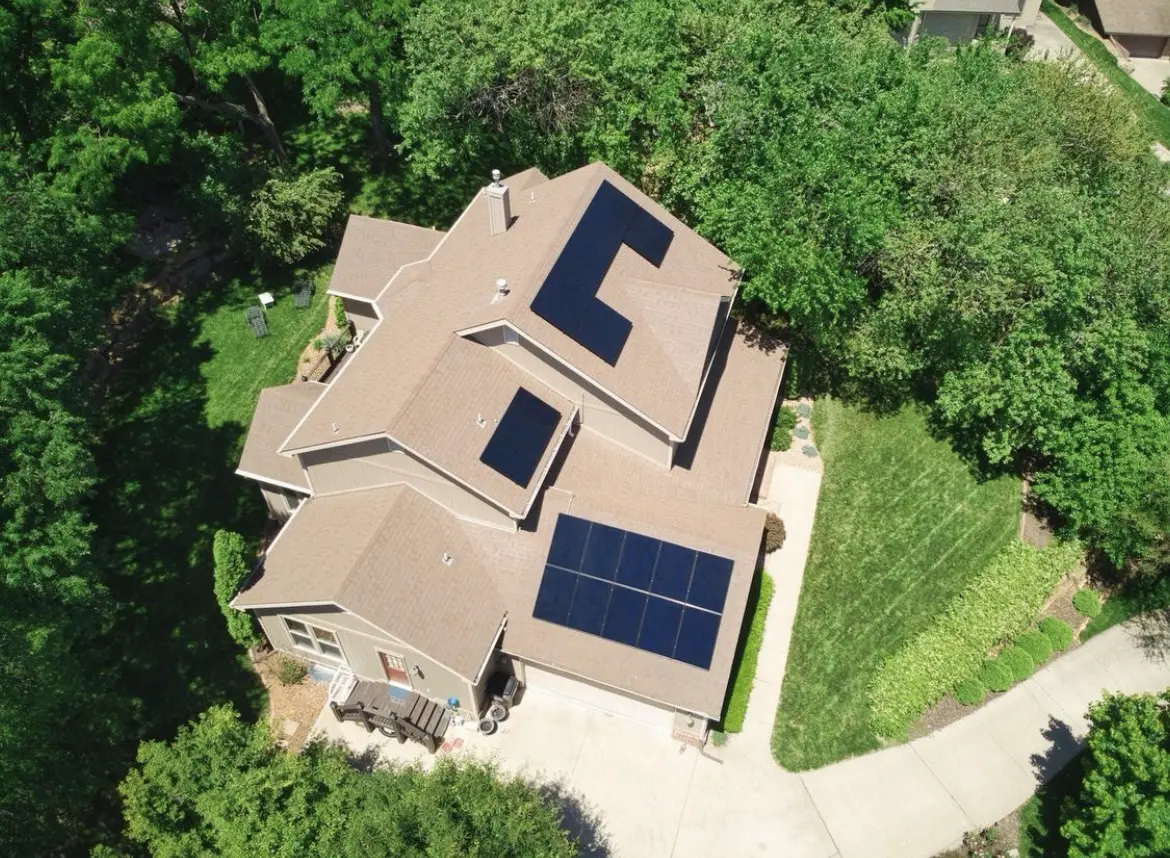
If your shingles have only a few seasons left, renewing them before mounting saves doing the job twice. Energy-efficient roof replacement and detach and reattach make that order simple to follow. Ohio businesses can ask us about commercial solar as well.

Charging on your own sunshine
Every mile charged from your array is power you did not export at the lower credit. Home EV charging and smart home controls make daytime charging automatic.
Ohio solar, answered
How does Ohio credit the solar power I export?
Any surplus beyond what you use in a billing month becomes a monetary credit, valued at the supply portion of your utility’s standard service offer. The credit carries forward onto future bills. The power you use yourself is never exported at all, so it saves you the full delivered price.
Is there an Ohio state tax credit or rebate for home solar?
Ohio’s support works through your bill rather than through a state credit or rebate: net metering, credits that carry forward, and a simple interconnection path for typical home systems. With the federal residential credit now ended, that bill value is what we model for you.
How large a system am I allowed to install?
Ohio expects net-metered systems to be sized mainly to offset your own consumption, with a cap set a little above your historical usage. Your utility can help estimate that figure from recent years of bills, and we work within it when we design.
Will a battery keep my house running in an outage?
A properly configured battery keeps chosen circuits powered when the grid goes down, and solar can recharge it during the day. Ohio has seen long outages from summer windstorms, so we size storage around what you want running, whether that is a few essentials or most of the house.
If you are thinking about solar, a battery or an efficiency upgrade anywhere in Ohio, send us a recent bill and tell us who delivers your power. We will show you how much of your own sunshine you could use at home and what the right system looks like for your household.